for a child runner, unning CdA is roughly around 0.24 m2, so pinning the ears back reduces drag by:
0.0014 / 0.24 =0.006
about 0.6% less air drag
At 7 m/s, power saved is:
ΔP = 1/2 1.225 7^3 * 0.0014
ΔP = 0.3 watts
but air drag is only a small part of running effort. for sprinting, air resistance is roughly %8–13 of total energy/power cost. So a 0.6% reduction in the aero part gives only:
0.006 * 0.08 to 0.13 = 0.05% to 0.08%
less total effort
since drag also increses with v3, speed gain is smaller than that. Approximataly:
Δv/v ≈ fε / (1 + 2f)
where f is the aero fraction and ε is the drag-area reduction.
f = 0.08 to 0.13 , ε = 0.006:
Δv/v = 0.0004 - 0.0006
so at 7 m/s:
Δv = 0.003 to 0.004 m/s
at 100 m, that saves roughly: 0.005 to 0.008 seconds
realistic answer: a few milliseconds over 100 m.
the velcro's main performance advantage is psychological intimidation.


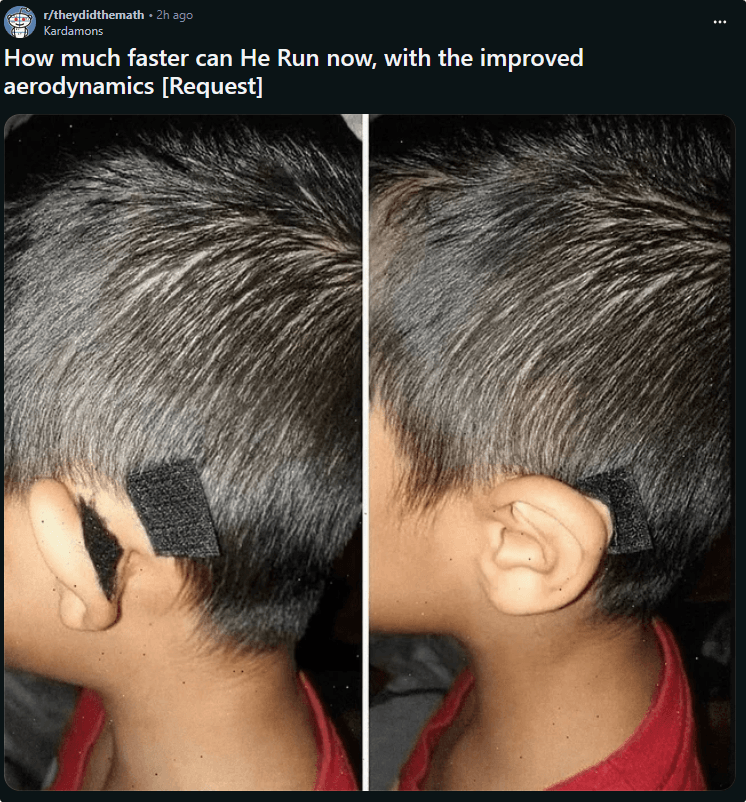
drag force:
D = 1/2 ρ v2 * CdA
and the power lost to drag:
P = Dv = 1/2 ρ v3 * CdA
assumptions:
air density: ρ = 1.225 kg/m3
running speed: 7 m/s,
ear height: 57 mm
normal ear projection from head: 20 mm
velecroed projection: 5 mm
both ears count so x2
ears are rounded so use a 0.7 exposure factor
ear/flat-plate-ish Cd 1.17
projected frontal area removed:
ΔA = 2 0.057 (0.020 - 0.005) * 0.7
ΔA = 0.0012 m2
convert that to drag area:
ΔCdA = 1.17 * 0.0012
ΔCdA = 0.0014 m²
for a child runner, unning CdA is roughly around 0.24 m2, so pinning the ears back reduces drag by:
0.0014 / 0.24 =0.006
about 0.6% less air drag
At 7 m/s, power saved is:
ΔP = 1/2 1.225 7^3 * 0.0014
ΔP = 0.3 watts
but air drag is only a small part of running effort. for sprinting, air resistance is roughly %8–13 of total energy/power cost. So a 0.6% reduction in the aero part gives only:
0.006 * 0.08 to 0.13 = 0.05% to 0.08%
less total effort
since drag also increses with v3, speed gain is smaller than that. Approximataly:
Δv/v ≈ fε / (1 + 2f)
where f is the aero fraction and ε is the drag-area reduction.
f = 0.08 to 0.13 , ε = 0.006:
Δv/v = 0.0004 - 0.0006
so at 7 m/s:
Δv = 0.003 to 0.004 m/s
at 100 m, that saves roughly: 0.005 to 0.008 seconds
realistic answer: a few milliseconds over 100 m.
the velcro's main performance advantage is psychological intimidation.
не учтен вес липучки. расчет неточен
снимет футболку и компенсирут десятикратно
тогда нужно будет учитывать аэродинамическое сопротивление сосков и пупка
ШТОШ... тут я пас!
один пас не пидорас
https://www.reddit.com/r/theydidthemath/...